
AI coworkers for operations teams
A 24/7 AI coworker. Live in a week. Free.
Hand the work that piles up to a coworker that never clocks off. We build it around how your team already works and run it on your real work for a week. You only pay if you keep it.
Fits into the tools your team already lives in
- Outlook
- Microsoft 365
- Microsoft Teams
- SlackSoon
- Gmail
- Google Workspace
- Excel
- Your ERP
- Carrier and supplier portals
- PDFs and scans
- Shared folders
Meet your team
Start with the queue that never clears.
Each AI coworker takes one job off your team’s hands, start to finish. It works in your systems, follows your rules and checks with you when it needs your judgment.
Quote requests arrive as emails, PDFs, even photos of handwritten notes. Each one waits for someone to read it, find a price and write back. And the customer who hears back first usually books.
What Quotes does
- Reads every request, whatever shape it arrives in.
- Checks carrier portals and asks your usual suppliers.
- Prices it with your margins.
- Writes the reply the way your team would.
Always asks you first
- Before any quote goes to a customer.
- When a margin falls below your rule.
Reading 3 PDFs Anna sent at 09:12
Every supplier invoice should be checked against what was agreed. In a busy month nobody has the time, and small overcharges quietly add up.
What Invoices does
- Reads every supplier invoice.
- Matches each line to the shipment and the agreed rate.
- Spots what was overbilled.
- Drafts the note to the supplier.
Always asks you first
- When it can’t tell which shipment an invoice is for.
- Before anything is posted, paid or disputed.
Checking 14 invoices from this morning
Hundreds of messages a day, and each one needs reading, sorting and a next step. Your best people end up running a switchboard.
What Inbox does
- Reads and sorts every message.
- Answers “where is my shipment?” straight from your systems.
- Hands the rest to the right person, with the context attached.
Always asks you first
- Before any reply your rules don’t already cover.
Sorted 212 messages since 07:00
What was ordered, what arrived and what was invoiced live in different portals, PDFs and spreadsheets. Someone has to make them agree.
What Orders does
- Reads orders, delivery notes and invoices.
- Matches them line by line.
- Shows you only what doesn’t match, with the documents attached.
Always asks you first
- Before it changes anything in your system.
Matching yesterday’s deliveries
A declaration needs every field right, built from documents that rarely agree. One wrong code and a shipment sits at the border.
What Customs does
- Reads commercial invoices and packing lists.
- Prepares the declaration.
- Checks codes and restricted goods.
Always asks you first
- You or your broker review it before anything is submitted.
Preparing 2 declarations
The product
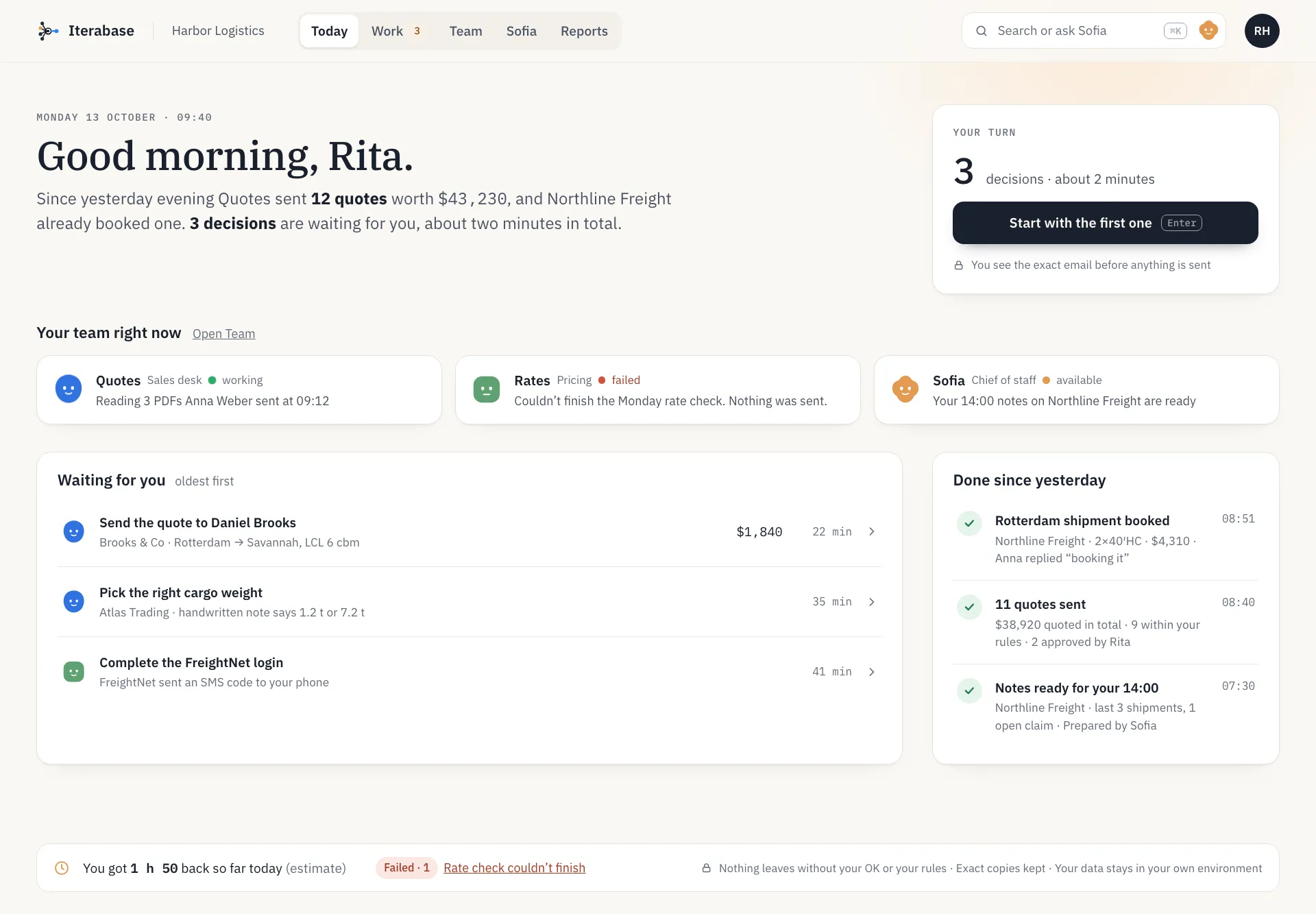
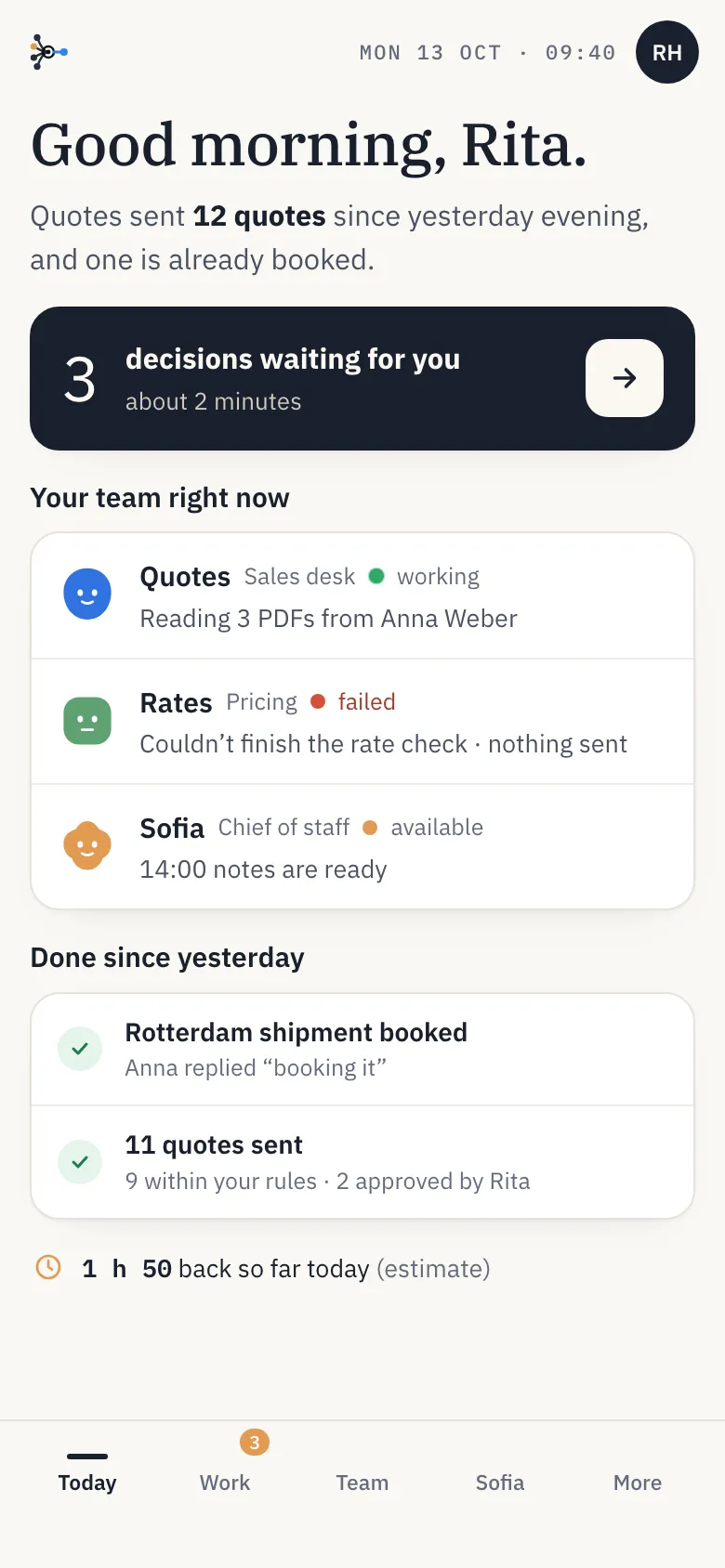
A day with your team.
This is the real app, with sample data. Your morning starts with a short note from your team, not another dashboard.
Coming soonBuild with Sofia
Build the next coworker by asking.
Describe a job in plain words, the way you’d brief a new hire. Sofia turns it into a workflow you can read, and nothing runs until you approve it.
- Say it your way
No forms, no flowcharts. Tell Sofia what needs doing and when.
- See every step and rule
What it will check, what it will send, and when it asks you first.
- You approve, then it runs
Start small, watch it work, and change it any time by asking.
Security and trust
Your data stays yours.
Simple rules, kept every single time.
You see the exact email before it goes.
Every email, quote or submission waits for your OK, unless a rule you agreed covers it. You see who prepared it and what was checked, so saying yes takes seconds.
Your own environment
Every company gets its own, walled off from everyone else. Hosted by us or on your servers.
Every file checked first
Attachments and downloads are scanned for viruses before a coworker opens them, so nothing harmful slips in.
No training, no keeping
The AI models run under written zero data retention. They don’t keep your data, and nothing trains on it.
Passwords stay locked
Logins to your systems are write-only. Nobody can read them back, not even us.
Every action has a name
You always know who prepared something, who approved it and when. What goes out is kept exactly as sent.
Deleted if you stop
Stop after the free week and we delete your data. No strings.
How it works
Two weeks from now, it’s off your plate.
You bring one process. We build it, run it on your real work and show you the hours it gave back. You only pay if you keep it.
-
Day 0
A 30-minute call
Tell us where the work piles up. We pick the right first job together.
You leave with a plan -
Days 1 to 7
We build it, free
You share access, a few real examples and one person to check the work.
Learns your rules -
Day 7
It goes live
Your AI coworker starts on real work, in its own environment.
Quotes is working -
Days 8 to 14
A week of real work
See what it did, what it asked you, and the time it gave back.
≈ 14 h back · estimate -
Day 14
You decide
Keep it with us, move it to your servers, or walk away.
No cost if you stop
Your two weeks could start this week. Then we take on the next job, one at a time, so your team keeps up.
Book a 30-minute callWhat it costs
Free to start. Simple after that.
Your first AI coworker is free.
We build it and run it on your real work for a week. If it doesn’t earn its place, it ends there. No cost, no obligation.
Hosted by us
Your own environment, built, run and looked after by us. Billed yearly.
On your servers
Run it inside your own infrastructure, for good. We scope it with you on the call.
Plans grow as your team does. We’ll size yours on the call.
Questions
Questions teams ask us.
What does it cost?
Your first AI coworker is free. We build it and run it on your real work for a week.
If you keep it, hosted plans start at €790$990 a month, billed yearly. Or buy a licencelicense and run it on your own servers.
What happens after the week?
It’s your call. Keep it running with us, move it to your own servers, or stop.
If you stop, you pay nothing and we delete your data.
How long until it’s live?
About a week from our first call. You give us access, a few real examples and one person to check the work. We handle the rest.
What systems can it use?
Email, spreadsheets, PDFs and scans, shared folders, your ERP and supplier or carrier portals.
If a system has no usable API, your AI coworker uses it the way a person would, within limits you approve.
Where does our data go?
Your company gets its own environment, shared with no one. It runs with us or on your servers.
The AI models it uses run under written zero data retention. They keep nothing, and nothing trains on your data.
What if it gets something wrong?
Nothing leaves without your OK or a rule you agreed, and you see the exact email or document first.
If something fails, it stops and tells you plainly. It never pretends it worked.
Who owns it?
Your data is yours. Hosted plans include the build and running it for you. A self-hosted licencelicense lets you run it on your own servers for good.
Is this just a chatbot?
No. A chatbot waits for you to ask. An AI coworker owns one job from start to finish, with its own tools and your rules.
And when you do want to ask something, Sofia, your chief of staff, knows what everyone is working on.
Why not just use ChatGPT or Claude?
They’re great assistants, but someone still has to open them, paste the work in and copy the answer back out.
An AI coworker does the work itself, inside your inbox, ERP and portals, by your rules, around the clock. Nothing leaves without your OK, it all runs in your own environment, and we build and run it for you.
Bring one process. See it working in a week.
Your first AI coworker is free. If it doesn’t earn its place, it ends there and we delete your data.
- QuotesAnswers quote requests
- InvoicesChecks supplier invoices
- CustomsPrepares declarations
- SofiaYour chief of staff, for any question